













Listen to the full episode:
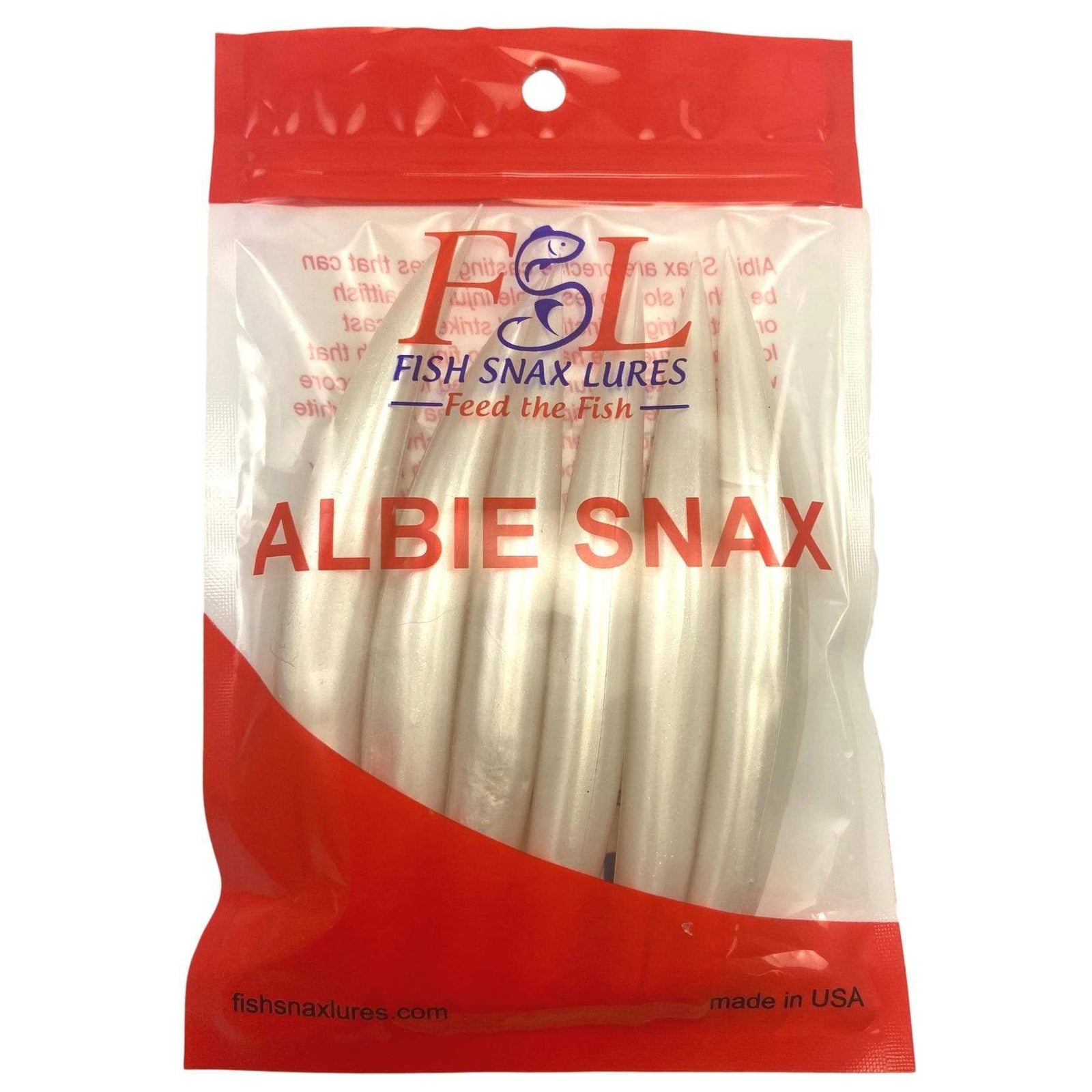
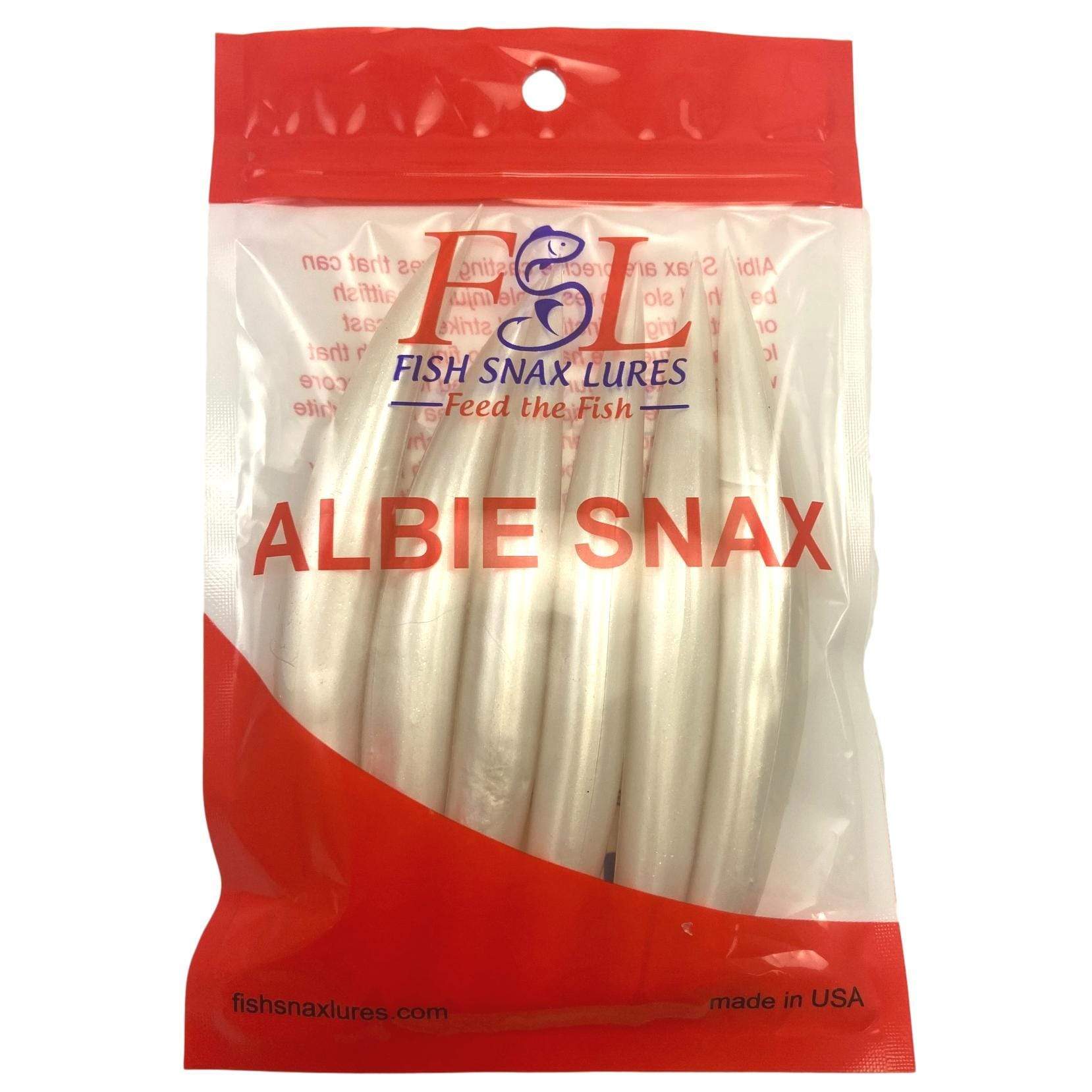
Some lures earn a spot in the bag for a season. A few earn one for good. The Albie Snax is in the second category — we sell roughly a thousand a year in white alone — and on this episode of the podcast, Peter sits down with the man who invented it, Alex Peru, to find out why it works as well as it does.
Alex grew up in Fairfield, Connecticut, turning wooden plugs and chasing false albacore. When nothing on the market matched what he was seeing on the water, he built his own — and the design thinking that went into that 5-inch soft plastic turns out to run a lot deeper than most of us realized. Here are the highlights.
The problem: a "weightless" lure that casts
Back in 2011, the standard albie arsenal was Deadly Dicks and Maria jigs. A few anglers were throwing weightless soft plastics — Zoom Flukes, Bass Assassins, small Slug-Gos — but as Alex points out, those were freshwater lures adopted into the salt, designed with zero thought given to casting distance.
His goal sounds like an oxymoron: a weightless soft plastic that casts, without adding anything that isn't soft plastic. The insight came from plug building. Wooden plugs — even floating ones — cast beautifully, not because they're heavy, but because they fly rigid. A skinny soft plastic flops in the air and kills its own flight. Make the bait thicker and it stiffens up, the same way a thin stick bends but a thick one holds itself straight.
So the answer was simply more plastic. A 5-inch Albie Snax weighs about a half ounce — roughly double a comparable bait — not because it's denser, but because there's twice the material. That's also why it's cylindrical: a round cross-section packs the most plastic into a slim baitfish profile. It required a trickier two-piece mold, poured through the nose under pressure (most soft plastics are poured flat in an open-top mold, which is why they have a flat side), but the payoff was a bait that casts like a bullet and still sinks at the same slow, neutral rate.
Rigging tips straight from the inventor
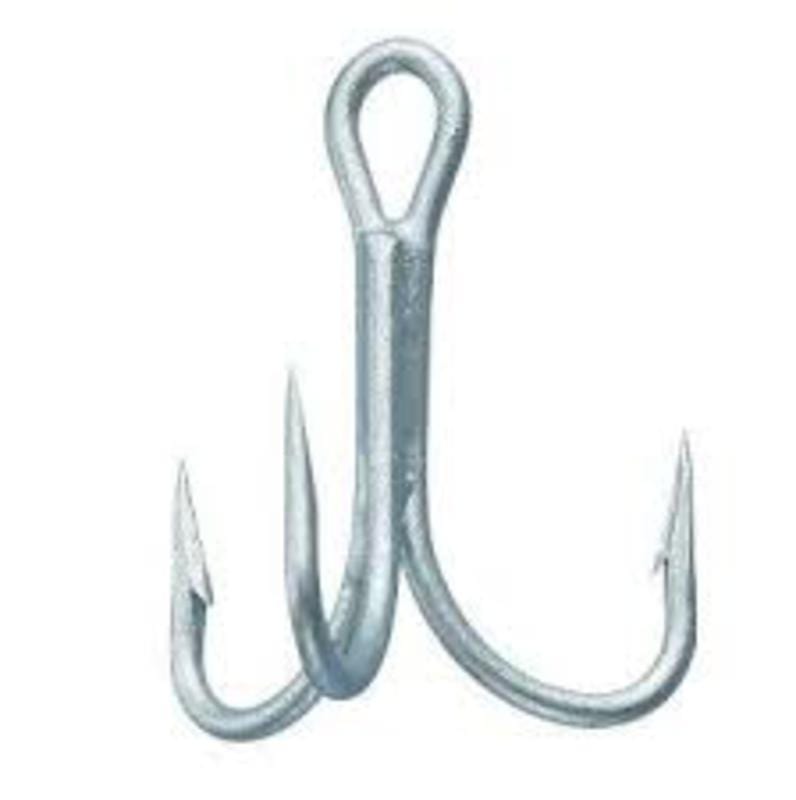
- Go screw-lock. Alex fishes it on a screw-lock (swimbait-style) hook nearly all the time — it's stronger than the old Z-bend nose rig, improves the hookup ratio, and stiffens the front half of the bait, which actually helps casting. Grab the purpose-built Albie Snax Hooks, Fish Snax Twistlock Hooks, or Owner Beast Hooks.
- Rotate and re-rig. Because the bait is round, once one hook slot wears out you can turn it a quarter turn and rig it fresh. You get far more mileage per bait than with any flat-topped soft plastic.
- Bury the point in the weeds. Alex normally rigs the hook point flush, but skips it weedless — point buried back into the bait — when he's throwing into grass or skipping under mangroves for snook.
- Try the subtle nose rig. For a more natural presentation, bury a screw-lock in the nose and run a thin-wire hook (think wacky-rig style) through it, in and out. The screw-lock keeps it from pulling free.
- Flip the two-tones. The bait keels with the hook, so you can run the two-tone colors dark-side-up or flip them — your call.
Don't forget the squid
One of the best moments in the episode: why the amber Albie Snax is so good. When bait is tightly schooled, the albies and stripers aren't the only ones eating — squid are almost always feeding on the same biomass, and predators will jump the ladder of the food chain to take the bigger morsel. As Alex puts it: why eat a sand eel when you can eat a squid that just ate five sand eels? This year's squid-heavy striper fishing made the point better than any seminar could.
Plot twist: the Super Snax came first
Most people assume the Super Snax was the follow-up to the Albie Snax. It was actually the original — the bigger bait is easier to hand-pour through the nose, so it came off the bench first. The Albie Snax was just the first big hit.
The 7-inch Fish Snax XL solves the scaling problem in a clever way: a long, slender bait gets floppy in the air, so the XL's tail folds against the body during the cast — you're essentially casting a short rigid lure — and then unfolds in the water for the full action. With a full ounce of plastic to work with, it can afford design touches like a pintail that the original 5-incher couldn't.
The Freak: reverse-engineering the spook
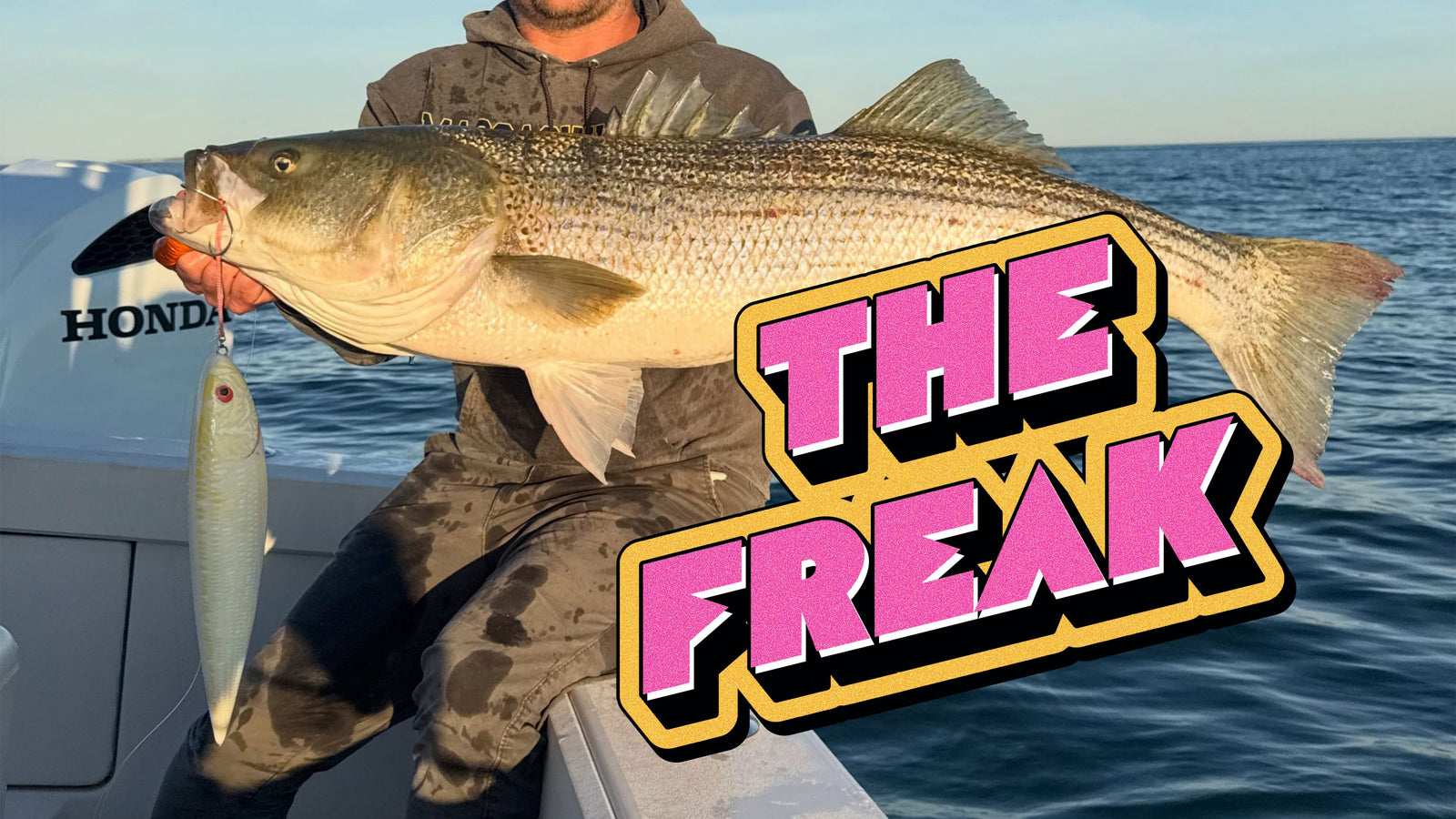
Alex has since sold Fish Snax (back in 2016 — the current crew has run it longer than he did), and his new company, Clobber, is aimed squarely at big striped bass. Its first lure is The Freak: an 11-inch, 4-plus-ounce glide spook. There's a 14-inch prototype in the works.
The starting point was the Doc. Alex watched it mesmerize fish — and also watched the biggest bass follow it and refuse to commit. His diagnosis: profile. A cylindrical spook doesn't look much like a bunker, a herring, or a shad from below — the baits big stripers key on are flat-sided and deep-bodied. The Freak is shaped like one of those baitfish, so the fish that comes in curious has one less reason to turn away.
Three design details worth knowing:
- A sliding magnetic weight. The weight releases into the tail on the cast (distance), then one twitch locks it back into the belly so the lure sits level at rest — the way a real fish sits. A tail-weighted spook hangs nose-up on the pause, which is exactly when a following bass is deciding.
- It skips on entry. A splash here, then another splash over there — very bunker-like, and it lets you skip the lure into boulder fields instead of flying a 4-ounce lure into the rocks.
- A nose-rigged single hook. Big stripers hit a baitfish in the head, because a baitfish can only swim forward. On a big rigid lure, a belly treble means those committed head-strikes knock the lure out of the fish's mouth. A tethered single hook on the nose gets eaten independent of the lure, locks around the jaw like a mechanical latch, and takes away the leverage fish use to throw hooks.
How to work a glide spook
The tip that will fix most people's walk-the-dog: keep your rod tip down and watch your line, not your lure. The glide comes from the drag of the line in the water — each twitch pulls from the midpoint of the line's belly, and that's what swings the lure. Rod tip down keeps the line in the water and the tension consistent. (It's also why a sloppy chop makes spook fishing harder.)
Curiosity vs. commitment
The thread running through the whole conversation: the action that calls a fish in and the action that converts the strike are not the same thing. A popper might pull more fish from distance, but if it doesn't look right at the final moment, you get follows, not hookups. Profile, a natural rest posture, and an evasive action that reads like fleeing prey — that's what turns a curious fish into a committed one. Alex's analogy: it's the cat toy pulled around the corner. The disappearing, escaping thing is what flips the kill switch.
Alex's picks
Two lures he actually fishes: the Albie Snax (rigged weightless — fast, slow, dead-stick, everything in between) and the Fish Snax XL as the bridge bait — plus, honestly, The Freak, which is what's tied on most nights now. Two planning resources: a nautical chart for structure and depth — Navionics on his phone — and Google Earth.
And his last day on Earth? He's flying to Africa to throw a giant Albie Snax at Nile perch — a fish he describes as a snook the size of the Hulk. Fitting for a guy whose great uncle, Lou Marron, still holds the all-tackle swordfish record: 1,182 pounds, set in 1953.
Shop the episode
- Albie Snax
- Fish Snax Super Snax
- Fish Snax XL
- Albie Snax Hooks 4/0
- Fish Snax Twistlock Hooks
- Owner Twistlock Beast Hooks
The Freak is currently hand-made and sold in small drops through Clobber — follow them on Instagram to catch the next one. https://www.instagram.com/clobber_company/



Leave a comment (all fields required)